


Help Center

Content Library

Careers
The Smarties Stat: How Fanatics, GoPuff & Seek Are Turning Fandom Into Verified Sponsorship Data

Taylor Werges
·
May 19, 2026
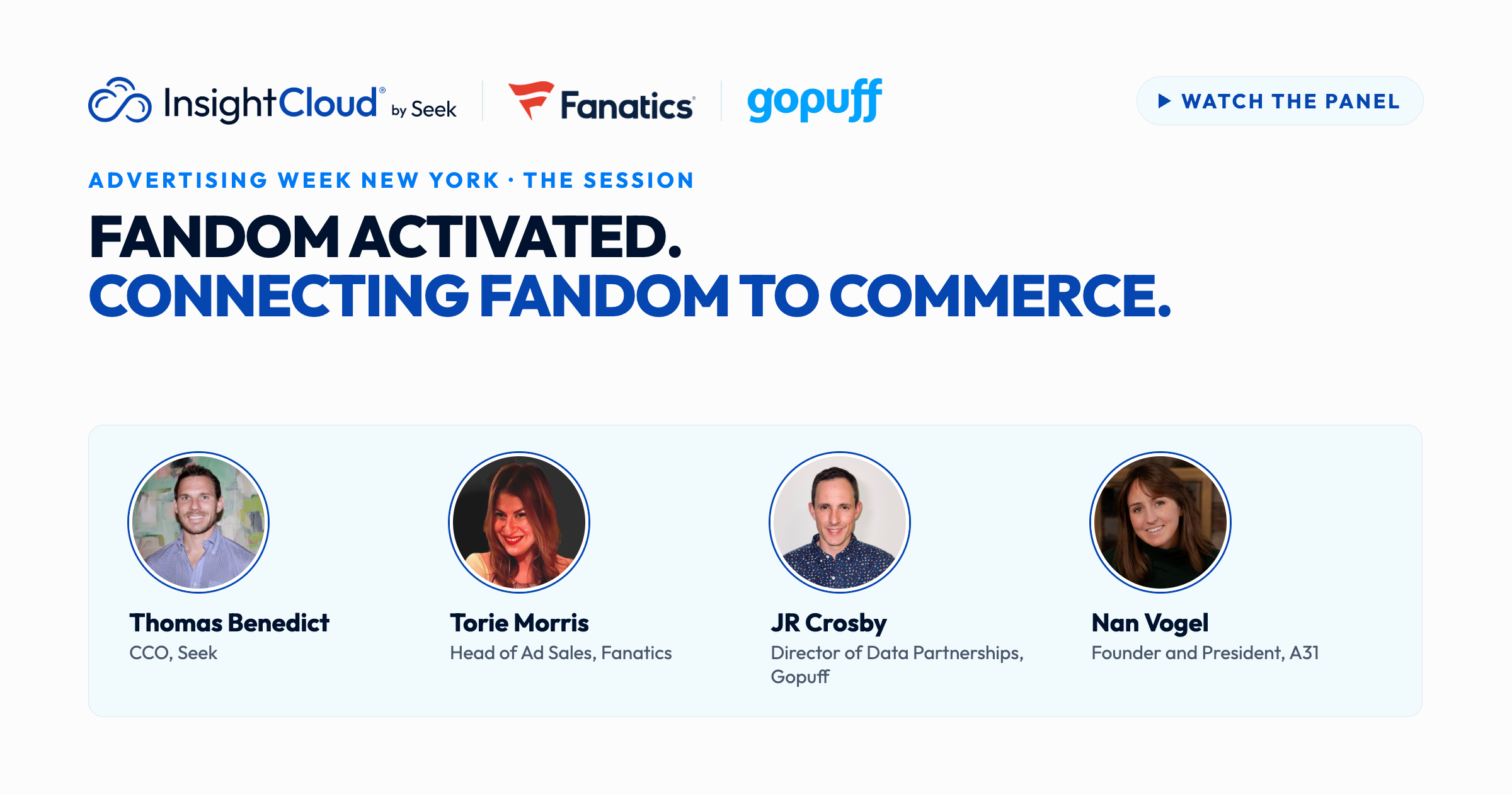
At Advertising Week New York, Seek's Thomas Benedict sat down with Fanatics, Gopuff, and sports-marketing veteran Nan Vogel to unpack a new data collaboration now live inside Insight Cloud. The premise: stop guessing which fans actually buy what, and start proving it — pairing Fanatics' verified purchase data with Gopuff's real-time commerce signals in one interactive environment, not a static clean-room report.
Quick takeaways
- Insight Cloud now connects Fanatics' verified fan purchase data with Gopuff's real-time commerce data in one interactive environment — not a one-off clean-room join.
- Fanatics draws from 900+ e-commerce sites, Lids' 1,400 retail stores, Topps, and its sportsbook to track what fans actually buy, return, and collect across 140+ million U.S. shoppers.
- Gopuff's instant-delivery model turns ad airtime into near-real-time signal — Kinder Bueno saw a 100% sales lift within an hour of its Super Bowl ad.
- About 70% of fans don't live where their favorite team plays, which is why purchase data beats zip-code assumptions.
- The roadmap expands beyond NFL and NCAA into sponsorship-fit tools, emerging-athlete tracking, and leagues from Formula One to FIFA.
The Smarties Question
Thomas Benedict, who leads Seek's commercial team, opened with a question for the room: which NFL fan base buys the most Smarties?
The audience guessed Buffalo Bills. Then Jets. Both wrong, more or less — the real answer is the Jets' home state anyway, but not because of fandom. Smarties has been manufactured in New Jersey since 1949. Proximity, not loyalty, drives the number.
That's the kind of insight Thomas was there to introduce: a new collaboration between Fanatics and Gopuff data, now live inside Insight Cloud.
"I want to be clear, because you probably all know what a clean room is — this isn't a clean room. This isn't just a report on a join. This is an interactive way to look into fandom and commerce and what people are buying, when they're buying it, what teams and leagues they're fans of." — Thomas Benedict, Seek
Joining him on stage:
- Nan Vogel — founder, A31 (formerly MLS, Gotham FC, MSG)
- Tori Morris — leads sales, Fanatics Advertising (formerly Netflix, Google)
- J.R. Crosby — leads data partnerships at Gopuff (formerly Zenith, GroupM)
Proving the Partnership, Not Just Pitching It
Nan Vogel has sold partnerships from both the iconic-brand side (the Knicks, the Rangers at MSG) and the smaller-but-mighty side (MLS, Gotham FC). Her framing: some properties win on reach and scale, others win on "riches and niches" — a smaller, more valuable fan base that's younger, more affluent, and more likely to actually buy what a sponsor sells. Women's soccer fans, she said, sit at the far end of that spectrum, rewarding sponsors because they see the spend as funding the players' ability to compete.
That thesis led to real money. While at Gotham FC, Vogel's team signed Dove to what became the league's largest-ever investment in a back-of-kit position. The deal was values-aligned from the start — Dove's 25-year body-confidence campaign matched Gotham's own "Keep Her in the Game" platform for girls at the age they typically quit sports. But alignment alone didn't close it.
"We have done some research that says our fans are more likely to buy a personal care brand like Dove, but we can't prove it," Vogel said of pitching it at the time. "So we're kind of just going on a hope and a prayer."
Insight Cloud removes the hope and the prayer. The platform shows that Philadelphia Eagles fans buy more Dove products than any other NFL fan base — the kind of specific, verifiable stat that turns a sponsorship pitch into an opening line, not a leap of faith.
"We don't have the scale, but we do have the value." — Nan Vogel, A31
What "Verified Fan" Actually Means
Tori Morris drew a hard line between Fanatics' data and the modeled, lookalike data most platforms sell against.
"It is not modeled data. It is not a lookalike audience. We know the hat you buy. We know the jersey you buy. We know when you return the jersey because your player or your team has vastly disappointed you. We know the bet you're placing." — Tori Morris, Fanatics
The scale behind that claim: Fanatics operates more than 900 e-commerce sites — every team and league shop imaginable — plus Lids' 1,400 physical retail locations, new collectibles retail stores, trading-card company Topps, and the third-largest sportsbook in the country. Across it all, Fanatics tracks over 140 million people in the U.S.
That footprint matters because fandom doesn't stop when the season does. "We are not a country that says, okay, it's football season, I'm going to watch for four months, and then I'm going to turn it off," Morris said. Fanatics built its fan graph to track that behavior day by day, not just during games — which is why the data reads as durable intelligence rather than a seasonal spike.
Speed Is the Signal Gouff Brings
If Fanatics proves who fans are, Gopuff proves what they do in the moment. J.R. Crosby described the company's core competency as speed — capitalizing on impulse the instant a consumer has a need.
Gopuff publishes a brand report every year, the day after the Super Bowl, tracking product sales as they roll in alongside the game and its commercials. Last year's standout: Kinder Bueno saw a 100% sales lift within an hour of its ad airing. Liquid Death and Liquid IV saw similar upticks across the board.
"These ads matter," Crosby said, "and they're driving people's interests and purchases in real time." That's a different read than a monthly sales report can offer. A month-end number tells you what happened; GoPuff's data tells you what was happening for that person, at that moment — the gap a slower CPG data set can't close.
Why Fanatics Opened Its Data — Carefully
Fanatics has historically guarded its data closely, so Morris walked through what had to be true before the company would expose it for activation. Three conditions, in order of priority: control over where the data moves and who can access it; full visibility into how matching happens and where insights get exported; and partners — Seek and GoPuff — that protect data with the same rigor Fanatics does.
Crosby added the industry context. Five or ten years ago, he said, any conversation with a retailer about their data started with no — often tangled up in internal disputes over whether IT or the ads division owned it. Clean-room technology opened the door to using that data safely. But the real unlock, in his view, isn't running a clean room for internal use — it's putting that insight directly into the hands of brands and agencies.
"This is the year of data collaboration," Crosby recalled hearing at a recent retail media conference — data owners working together in non-competitive environments to build a fuller, more actionable picture of their shared audiences, grounded in analytics and insight rather than a media buyer cherry-picking segments in a DSP.
Beyond the NFL: What's Next
Morris framed the roadmap in three stages:
Launch (live today): Game-day insights that show how fandom moves throughout a season and within a single game, sliced by team and league. Fan audience insights that reveal geographic mismatches — about 70% of fans don't live in the city or state where their favorite team plays, which is part of why Fanatics built an e-commerce model in the first place. A New York–based Detroit Lions fan can't walk into a local store for gear; Fanatics exists to serve exactly that audience.
Expand: Sponsorship insight tools that help brands and agencies choose which leagues, teams, and athletes to back. Emerging-athlete tracking that flags which incoming players are already driving sales — Nan referenced the moment this played out live on stage: shortly after basketball prospect AJ Dybantsa signed with Red Bull, the panel noted that Washington Wizards fans over-index on Red Bull purchases.
Scale: Fanatics' 900-plus sites cover far more than the NFL and NCAA — every level from D3 to D1, Formula One, FIFA, and more — plus first-party data from events like Fanatics Fest, where more than 200,000 people spend four days and buy heavily. The goal is to build more apps like the GoPuff collaboration, in partnership with other retailers, agencies, and clients, and scale them across that full footprint.
The Red Sox/White Claw example came up as a preview of where this leads: Fanatics data shows Red Sox fans over-index on White Claw purchases, even though Boston Beer (maker of Truly) is the team's sponsor — a conquesting opportunity an existing sponsorship data set wouldn't surface on its own.
The Bottom Line for Brands
Asked what a brand should do Monday morning, Crosby kept it practical: understand your category position first — where you're winning, where you're losing, with which audiences — before bringing data into the room. Come in grounded in what the client is actually trying to achieve, whether that's a demographic target or a specific team affinity, and build the plan from there.
Vogel's closing point tied it together: more data only matters if it changes what you do next. Knowing the Smarties stat in advance, she said, would have given her a new pipeline of sponsor targets to approach — not just a talking point once in the room. It's less about volume of data and more about working smarter, leaning into what's already resonating, and making an existing partnership perform harder for both sides.

Taylor Werges
·
May 19, 2026

The intelligence platform
for the modern analyst.
© Seek 2026

Resources

Help Center
Content Library
Careers
The Smarties Stat: How Fanatics, GoPuff & Seek Are Turning Fandom Into Verified Sponsorship Data
Taylor Werges
·
May 19, 2026
At Advertising Week New York, Seek's Thomas Benedict sat down with Fanatics, Gopuff, and sports-marketing veteran Nan Vogel to unpack a new data collaboration now live inside Insight Cloud. The premise: stop guessing which fans actually buy what, and start proving it — pairing Fanatics' verified purchase data with Gopuff's real-time commerce signals in one interactive environment, not a static clean-room report.
Quick takeaways
- Insight Cloud now connects Fanatics' verified fan purchase data with Gopuff's real-time commerce data in one interactive environment — not a one-off clean-room join.
- Fanatics draws from 900+ e-commerce sites, Lids' 1,400 retail stores, Topps, and its sportsbook to track what fans actually buy, return, and collect across 140+ million U.S. shoppers.
- Gopuff's instant-delivery model turns ad airtime into near-real-time signal — Kinder Bueno saw a 100% sales lift within an hour of its Super Bowl ad.
- About 70% of fans don't live where their favorite team plays, which is why purchase data beats zip-code assumptions.
- The roadmap expands beyond NFL and NCAA into sponsorship-fit tools, emerging-athlete tracking, and leagues from Formula One to FIFA.
The Smarties Question
Thomas Benedict, who leads Seek's commercial team, opened with a question for the room: which NFL fan base buys the most Smarties?
The audience guessed Buffalo Bills. Then Jets. Both wrong, more or less — the real answer is the Jets' home state anyway, but not because of fandom. Smarties has been manufactured in New Jersey since 1949. Proximity, not loyalty, drives the number.
That's the kind of insight Thomas was there to introduce: a new collaboration between Fanatics and Gopuff data, now live inside Insight Cloud.
"I want to be clear, because you probably all know what a clean room is — this isn't a clean room. This isn't just a report on a join. This is an interactive way to look into fandom and commerce and what people are buying, when they're buying it, what teams and leagues they're fans of." — Thomas Benedict, Seek
Joining him on stage:
- Nan Vogel — founder, A31 (formerly MLS, Gotham FC, MSG)
- Tori Morris — leads sales, Fanatics Advertising (formerly Netflix, Google)
- J.R. Crosby — leads data partnerships at Gopuff (formerly Zenith, GroupM)
Proving the Partnership, Not Just Pitching It
Nan Vogel has sold partnerships from both the iconic-brand side (the Knicks, the Rangers at MSG) and the smaller-but-mighty side (MLS, Gotham FC). Her framing: some properties win on reach and scale, others win on "riches and niches" — a smaller, more valuable fan base that's younger, more affluent, and more likely to actually buy what a sponsor sells. Women's soccer fans, she said, sit at the far end of that spectrum, rewarding sponsors because they see the spend as funding the players' ability to compete.
That thesis led to real money. While at Gotham FC, Vogel's team signed Dove to what became the league's largest-ever investment in a back-of-kit position. The deal was values-aligned from the start — Dove's 25-year body-confidence campaign matched Gotham's own "Keep Her in the Game" platform for girls at the age they typically quit sports. But alignment alone didn't close it.
"We have done some research that says our fans are more likely to buy a personal care brand like Dove, but we can't prove it," Vogel said of pitching it at the time. "So we're kind of just going on a hope and a prayer."
Insight Cloud removes the hope and the prayer. The platform shows that Philadelphia Eagles fans buy more Dove products than any other NFL fan base — the kind of specific, verifiable stat that turns a sponsorship pitch into an opening line, not a leap of faith.
"We don't have the scale, but we do have the value." — Nan Vogel, A31
What "Verified Fan" Actually Means
Tori Morris drew a hard line between Fanatics' data and the modeled, lookalike data most platforms sell against.
"It is not modeled data. It is not a lookalike audience. We know the hat you buy. We know the jersey you buy. We know when you return the jersey because your player or your team has vastly disappointed you. We know the bet you're placing." — Tori Morris, Fanatics
The scale behind that claim: Fanatics operates more than 900 e-commerce sites — every team and league shop imaginable — plus Lids' 1,400 physical retail locations, new collectibles retail stores, trading-card company Topps, and the third-largest sportsbook in the country. Across it all, Fanatics tracks over 140 million people in the U.S.
That footprint matters because fandom doesn't stop when the season does. "We are not a country that says, okay, it's football season, I'm going to watch for four months, and then I'm going to turn it off," Morris said. Fanatics built its fan graph to track that behavior day by day, not just during games — which is why the data reads as durable intelligence rather than a seasonal spike.
Speed Is the Signal Gouff Brings
If Fanatics proves who fans are, Gopuff proves what they do in the moment. J.R. Crosby described the company's core competency as speed — capitalizing on impulse the instant a consumer has a need.
Gopuff publishes a brand report every year, the day after the Super Bowl, tracking product sales as they roll in alongside the game and its commercials. Last year's standout: Kinder Bueno saw a 100% sales lift within an hour of its ad airing. Liquid Death and Liquid IV saw similar upticks across the board.
"These ads matter," Crosby said, "and they're driving people's interests and purchases in real time." That's a different read than a monthly sales report can offer. A month-end number tells you what happened; GoPuff's data tells you what was happening for that person, at that moment — the gap a slower CPG data set can't close.
Why Fanatics Opened Its Data — Carefully
Fanatics has historically guarded its data closely, so Morris walked through what had to be true before the company would expose it for activation. Three conditions, in order of priority: control over where the data moves and who can access it; full visibility into how matching happens and where insights get exported; and partners — Seek and GoPuff — that protect data with the same rigor Fanatics does.
Crosby added the industry context. Five or ten years ago, he said, any conversation with a retailer about their data started with no — often tangled up in internal disputes over whether IT or the ads division owned it. Clean-room technology opened the door to using that data safely. But the real unlock, in his view, isn't running a clean room for internal use — it's putting that insight directly into the hands of brands and agencies.
"This is the year of data collaboration," Crosby recalled hearing at a recent retail media conference — data owners working together in non-competitive environments to build a fuller, more actionable picture of their shared audiences, grounded in analytics and insight rather than a media buyer cherry-picking segments in a DSP.
Beyond the NFL: What's Next
Morris framed the roadmap in three stages:
Launch (live today): Game-day insights that show how fandom moves throughout a season and within a single game, sliced by team and league. Fan audience insights that reveal geographic mismatches — about 70% of fans don't live in the city or state where their favorite team plays, which is part of why Fanatics built an e-commerce model in the first place. A New York–based Detroit Lions fan can't walk into a local store for gear; Fanatics exists to serve exactly that audience.
Expand: Sponsorship insight tools that help brands and agencies choose which leagues, teams, and athletes to back. Emerging-athlete tracking that flags which incoming players are already driving sales — Nan referenced the moment this played out live on stage: shortly after basketball prospect AJ Dybantsa signed with Red Bull, the panel noted that Washington Wizards fans over-index on Red Bull purchases.
Scale: Fanatics' 900-plus sites cover far more than the NFL and NCAA — every level from D3 to D1, Formula One, FIFA, and more — plus first-party data from events like Fanatics Fest, where more than 200,000 people spend four days and buy heavily. The goal is to build more apps like the GoPuff collaboration, in partnership with other retailers, agencies, and clients, and scale them across that full footprint.
The Red Sox/White Claw example came up as a preview of where this leads: Fanatics data shows Red Sox fans over-index on White Claw purchases, even though Boston Beer (maker of Truly) is the team's sponsor — a conquesting opportunity an existing sponsorship data set wouldn't surface on its own.
The Bottom Line for Brands
Asked what a brand should do Monday morning, Crosby kept it practical: understand your category position first — where you're winning, where you're losing, with which audiences — before bringing data into the room. Come in grounded in what the client is actually trying to achieve, whether that's a demographic target or a specific team affinity, and build the plan from there.
Vogel's closing point tied it together: more data only matters if it changes what you do next. Knowing the Smarties stat in advance, she said, would have given her a new pipeline of sponsor targets to approach — not just a talking point once in the room. It's less about volume of data and more about working smarter, leaning into what's already resonating, and making an existing partnership perform harder for both sides.

Taylor Werges
·
May 19, 2026

The intelligence platform
for the modern analyst.
© Seek 2026

Resources

Help Center
Content Library
Careers
The Smarties Stat: How Fanatics, GoPuff & Seek Are Turning Fandom Into Verified Sponsorship Data
Taylor Werges
·
At Advertising Week New York, Seek's Thomas Benedict sat down with Fanatics, Gopuff, and sports-marketing veteran Nan Vogel to unpack a new data collaboration now live inside Insight Cloud. The premise: stop guessing which fans actually buy what, and start proving it — pairing Fanatics' verified purchase data with Gopuff's real-time commerce signals in one interactive environment, not a static clean-room report.
Quick takeaways
- Insight Cloud now connects Fanatics' verified fan purchase data with Gopuff's real-time commerce data in one interactive environment — not a one-off clean-room join.
- Fanatics draws from 900+ e-commerce sites, Lids' 1,400 retail stores, Topps, and its sportsbook to track what fans actually buy, return, and collect across 140+ million U.S. shoppers.
- Gopuff's instant-delivery model turns ad airtime into near-real-time signal — Kinder Bueno saw a 100% sales lift within an hour of its Super Bowl ad.
- About 70% of fans don't live where their favorite team plays, which is why purchase data beats zip-code assumptions.
- The roadmap expands beyond NFL and NCAA into sponsorship-fit tools, emerging-athlete tracking, and leagues from Formula One to FIFA.
The Smarties Question
Thomas Benedict, who leads Seek's commercial team, opened with a question for the room: which NFL fan base buys the most Smarties?
The audience guessed Buffalo Bills. Then Jets. Both wrong, more or less — the real answer is the Jets' home state anyway, but not because of fandom. Smarties has been manufactured in New Jersey since 1949. Proximity, not loyalty, drives the number.
That's the kind of insight Thomas was there to introduce: a new collaboration between Fanatics and Gopuff data, now live inside Insight Cloud.
"I want to be clear, because you probably all know what a clean room is — this isn't a clean room. This isn't just a report on a join. This is an interactive way to look into fandom and commerce and what people are buying, when they're buying it, what teams and leagues they're fans of." — Thomas Benedict, Seek
Joining him on stage:
- Nan Vogel — founder, A31 (formerly MLS, Gotham FC, MSG)
- Tori Morris — leads sales, Fanatics Advertising (formerly Netflix, Google)
- J.R. Crosby — leads data partnerships at Gopuff (formerly Zenith, GroupM)
Proving the Partnership, Not Just Pitching It
Nan Vogel has sold partnerships from both the iconic-brand side (the Knicks, the Rangers at MSG) and the smaller-but-mighty side (MLS, Gotham FC). Her framing: some properties win on reach and scale, others win on "riches and niches" — a smaller, more valuable fan base that's younger, more affluent, and more likely to actually buy what a sponsor sells. Women's soccer fans, she said, sit at the far end of that spectrum, rewarding sponsors because they see the spend as funding the players' ability to compete.
That thesis led to real money. While at Gotham FC, Vogel's team signed Dove to what became the league's largest-ever investment in a back-of-kit position. The deal was values-aligned from the start — Dove's 25-year body-confidence campaign matched Gotham's own "Keep Her in the Game" platform for girls at the age they typically quit sports. But alignment alone didn't close it.
"We have done some research that says our fans are more likely to buy a personal care brand like Dove, but we can't prove it," Vogel said of pitching it at the time. "So we're kind of just going on a hope and a prayer."
Insight Cloud removes the hope and the prayer. The platform shows that Philadelphia Eagles fans buy more Dove products than any other NFL fan base — the kind of specific, verifiable stat that turns a sponsorship pitch into an opening line, not a leap of faith.
"We don't have the scale, but we do have the value." — Nan Vogel, A31
What "Verified Fan" Actually Means
Tori Morris drew a hard line between Fanatics' data and the modeled, lookalike data most platforms sell against.
"It is not modeled data. It is not a lookalike audience. We know the hat you buy. We know the jersey you buy. We know when you return the jersey because your player or your team has vastly disappointed you. We know the bet you're placing." — Tori Morris, Fanatics
The scale behind that claim: Fanatics operates more than 900 e-commerce sites — every team and league shop imaginable — plus Lids' 1,400 physical retail locations, new collectibles retail stores, trading-card company Topps, and the third-largest sportsbook in the country. Across it all, Fanatics tracks over 140 million people in the U.S.
That footprint matters because fandom doesn't stop when the season does. "We are not a country that says, okay, it's football season, I'm going to watch for four months, and then I'm going to turn it off," Morris said. Fanatics built its fan graph to track that behavior day by day, not just during games — which is why the data reads as durable intelligence rather than a seasonal spike.
Speed Is the Signal Gouff Brings
If Fanatics proves who fans are, Gopuff proves what they do in the moment. J.R. Crosby described the company's core competency as speed — capitalizing on impulse the instant a consumer has a need.
Gopuff publishes a brand report every year, the day after the Super Bowl, tracking product sales as they roll in alongside the game and its commercials. Last year's standout: Kinder Bueno saw a 100% sales lift within an hour of its ad airing. Liquid Death and Liquid IV saw similar upticks across the board.
"These ads matter," Crosby said, "and they're driving people's interests and purchases in real time." That's a different read than a monthly sales report can offer. A month-end number tells you what happened; GoPuff's data tells you what was happening for that person, at that moment — the gap a slower CPG data set can't close.
Why Fanatics Opened Its Data — Carefully
Fanatics has historically guarded its data closely, so Morris walked through what had to be true before the company would expose it for activation. Three conditions, in order of priority: control over where the data moves and who can access it; full visibility into how matching happens and where insights get exported; and partners — Seek and GoPuff — that protect data with the same rigor Fanatics does.
Crosby added the industry context. Five or ten years ago, he said, any conversation with a retailer about their data started with no — often tangled up in internal disputes over whether IT or the ads division owned it. Clean-room technology opened the door to using that data safely. But the real unlock, in his view, isn't running a clean room for internal use — it's putting that insight directly into the hands of brands and agencies.
"This is the year of data collaboration," Crosby recalled hearing at a recent retail media conference — data owners working together in non-competitive environments to build a fuller, more actionable picture of their shared audiences, grounded in analytics and insight rather than a media buyer cherry-picking segments in a DSP.
Beyond the NFL: What's Next
Morris framed the roadmap in three stages:
Launch (live today): Game-day insights that show how fandom moves throughout a season and within a single game, sliced by team and league. Fan audience insights that reveal geographic mismatches — about 70% of fans don't live in the city or state where their favorite team plays, which is part of why Fanatics built an e-commerce model in the first place. A New York–based Detroit Lions fan can't walk into a local store for gear; Fanatics exists to serve exactly that audience.
Expand: Sponsorship insight tools that help brands and agencies choose which leagues, teams, and athletes to back. Emerging-athlete tracking that flags which incoming players are already driving sales — Nan referenced the moment this played out live on stage: shortly after basketball prospect AJ Dybantsa signed with Red Bull, the panel noted that Washington Wizards fans over-index on Red Bull purchases.
Scale: Fanatics' 900-plus sites cover far more than the NFL and NCAA — every level from D3 to D1, Formula One, FIFA, and more — plus first-party data from events like Fanatics Fest, where more than 200,000 people spend four days and buy heavily. The goal is to build more apps like the GoPuff collaboration, in partnership with other retailers, agencies, and clients, and scale them across that full footprint.
The Red Sox/White Claw example came up as a preview of where this leads: Fanatics data shows Red Sox fans over-index on White Claw purchases, even though Boston Beer (maker of Truly) is the team's sponsor — a conquesting opportunity an existing sponsorship data set wouldn't surface on its own.
The Bottom Line for Brands
Asked what a brand should do Monday morning, Crosby kept it practical: understand your category position first — where you're winning, where you're losing, with which audiences — before bringing data into the room. Come in grounded in what the client is actually trying to achieve, whether that's a demographic target or a specific team affinity, and build the plan from there.
Vogel's closing point tied it together: more data only matters if it changes what you do next. Knowing the Smarties stat in advance, she said, would have given her a new pipeline of sponsor targets to approach — not just a talking point once in the room. It's less about volume of data and more about working smarter, leaning into what's already resonating, and making an existing partnership perform harder for both sides.

Taylor Werges
·

The intelligence platform
for the modern analyst.
© Seek 2026